
Paris
Introduction
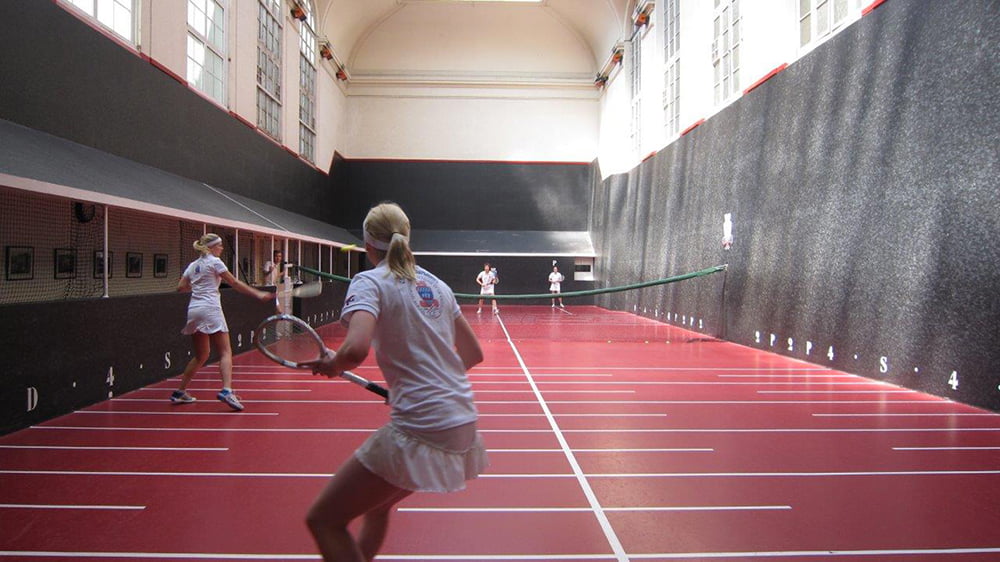
The Club du Jeu de Paume de Paris is a remarkable place. Perched on the top floor of a building on rue Lauriston, between the Arc de Triomphe and the Trocadéro, under a double glass roof thirty meters high, are four squash courts, a jeu de paume court, a fitness room and a bar/restaurant
Founded in 1908, the Club du Jeu de Paume de Paris houses one of the last two paume courts in the Paris region, along with the one at Château de Fontainebleau. At the time of its creation, the club housed two adjacent paume courts. But in 1927, the founders decided to transform one of the two courts into four squash courts, the first to be created in France.
Since then, the club has jointly developed squash and paume, enabling both sports to be played at a high level by players of all ages. Today, the club has over 300 members who come to train regularly.
What's special about the Jeu de Paume Club is that it remains a non-profit association under the French law of 1901. In concrete terms, this means that the association is not seeking to make a profit, but to manage the club in the best interests of its members. Thus, the Association organizes competitions and prestigious events for the enjoyment of its members, although these are not necessarily "profitable" or a source of profit for the club.
The Association is managed on a day-to-day basis by a board of volunteer members, who rely on the club's salaried staff to implement the decisions taken by the Board and the members of the Bureau. Board members are elected each year by a Committee of 12 members in principle, themselves elected each year by a General Meeting of members.
Practical information
Société́ sportive du jeu de paume et de racquets
74ter, rue Lauriston – 75116 Paris
Tel. +33 (0)1 47 27 46 86
Mail : manager@squashjeudepaume.com
Site internet : www.squashjeudepaume.com
______________________
Contact : Lilian Vimal de Murs
Tarifs : voir le site internet
Horaires :
Lundi au Vendredi 8h00 – 22h30
Week-end & Jours fériés 9h00 – 20h00
Pro paume : Rod McNaughtan
Contact :
propaume@squashjeudepaume.com
06 95 31 11 93
LHistory of the Jeu de Paume Club in Paris : 1840- 2020
HISTOIRE DU CLUB DU JEU DE PAUME DE PARIS: HIER & AUJOURD’HUI– 1840 – 2020
par Hubert DEMORY, Gil KRESSMANN, WILLIAM HOLMBERG & Nelcius PATRICIA GALAGHER
Born in the XIIIe century, jeu de paume — the ancestor of tennis, squash, and all racquet sports — has been one of the oldest sporting activities. It is still played today in England, Australia, the United States, and France by about 10,000 players. France now has only three real-tennis courts in operation, in Bordeaux, Fontainebleau, and Paris (to which should be added the court in Pau, partially reopened since 2007
The Club was built in 1908 on rue Lauriston in the 16the district (close to CDG Etoile) following the expulsion of the players from the Jeu de Paume court at the Tuileries, two real-tennis courts were built on the second floor of a stone building. A splendid Eiffel-style glass roof covers the courts, surrounded by tall windows that provide natural light. This building, now more than a century old, is undoubtedly one of the finest jewels of the sporting architectural heritage of the capital and of our country.
In 1927, the club leaders decided to open four squash courts by giving up one of the two real-tennis courts that was underused. These became the first squash courts available to residents of the capital.
The countless sporting competitions held in these venues for over 100 years have showcased the world’s best players in both disciplines. This historic site has also been home to the French Real Tennis Committee (CFCP), the coordinating body for real tennis in France, as well as, during its early years, the French Squash Federation.
By recounting the history of the Société Sportive du Jeu de Paume et de Racquets, one of the oldest sports associations in our country (in fact established in 1840), this book helps reveal a little-known part of the history of sports in our capital city.
Pour acheter le livre:
– version Francais disponible au clubs en France
– version en anglais via Ronaldson Publications ainsi au club de Paris.